

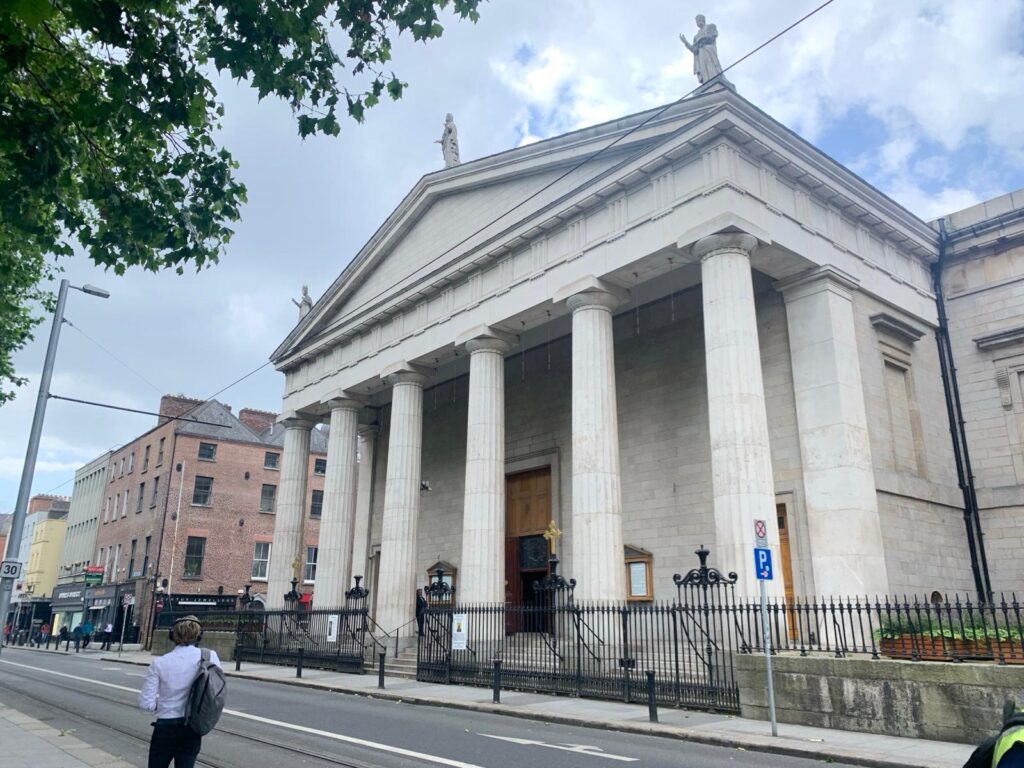

St Mary’s Cathedral, Dublin
Bicentenary Weekend
Homily of Bishop Paul Dempsey, Auxiliary Bishop of Dublin
Sunday, November 16
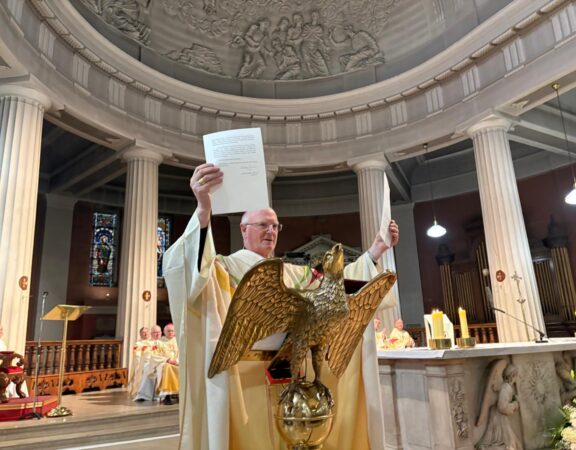
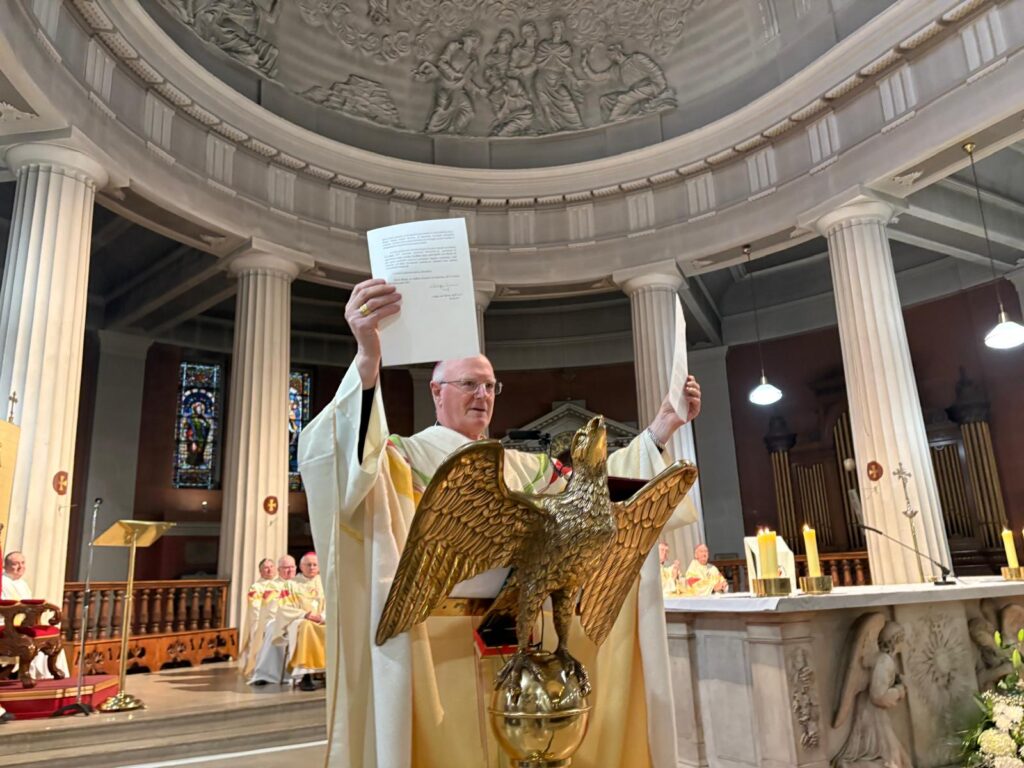
Jesus certainly puts things into perspective. Today we hear how so many people were admiring the beauty of the Temple which was so central to Jewish faith. But Jesus prophesises that in time it will all be destroyed. Implicit in his statement is the fact that there is something far greater than the Temple, he is pointing to that fact that he is that something greater. It is an interesting Gospel especially this weekend here in the Archdiocese of Dublin as we celebrate the Bicentenary of St Mary’s Cathedral. This building has been part of the story of the city and the Diocese for two hundred years. It has a fascinating history, so well-articulated by Fr Kieran McDermott, our Administrator, on the Nationwide Programme broadcast on RTÉ during the week. In the Catholic tradition over the centuries many beautiful places of worship have been built. It is important to return to why they were built. They are not built as tourist attractions or museums; they are places where the Church community gathers to worship the Lord. The beauty and aesthetics are there to help raise our minds and hearts to God and to draw us into the mystery that is God’s love.
St Mary’s was opened on the November 14, 1825. From around this time on, the Irish Church was to enter a very strong period of growth. Many of the churches, parochial houses and convents that we see around the country today were built from about the middle of the 19th Century. This symbolised the strong presence of the Church in Irish society. It continued for about one hundred and fifty years or so. Then we saw the beginnings of change, something that has escalated over the last two to three decades. We find ourselves in a very different place today. There can be a temptation to look to the past with rose tinted glasses when the churches were full, but as we know not all was well and serious issues needed to be faced. This process has been disconcerting for some who have a nostalgia for the past and want to go back to the way it was. However, nostalgia could be described as a looking into the past with the pain taken away.
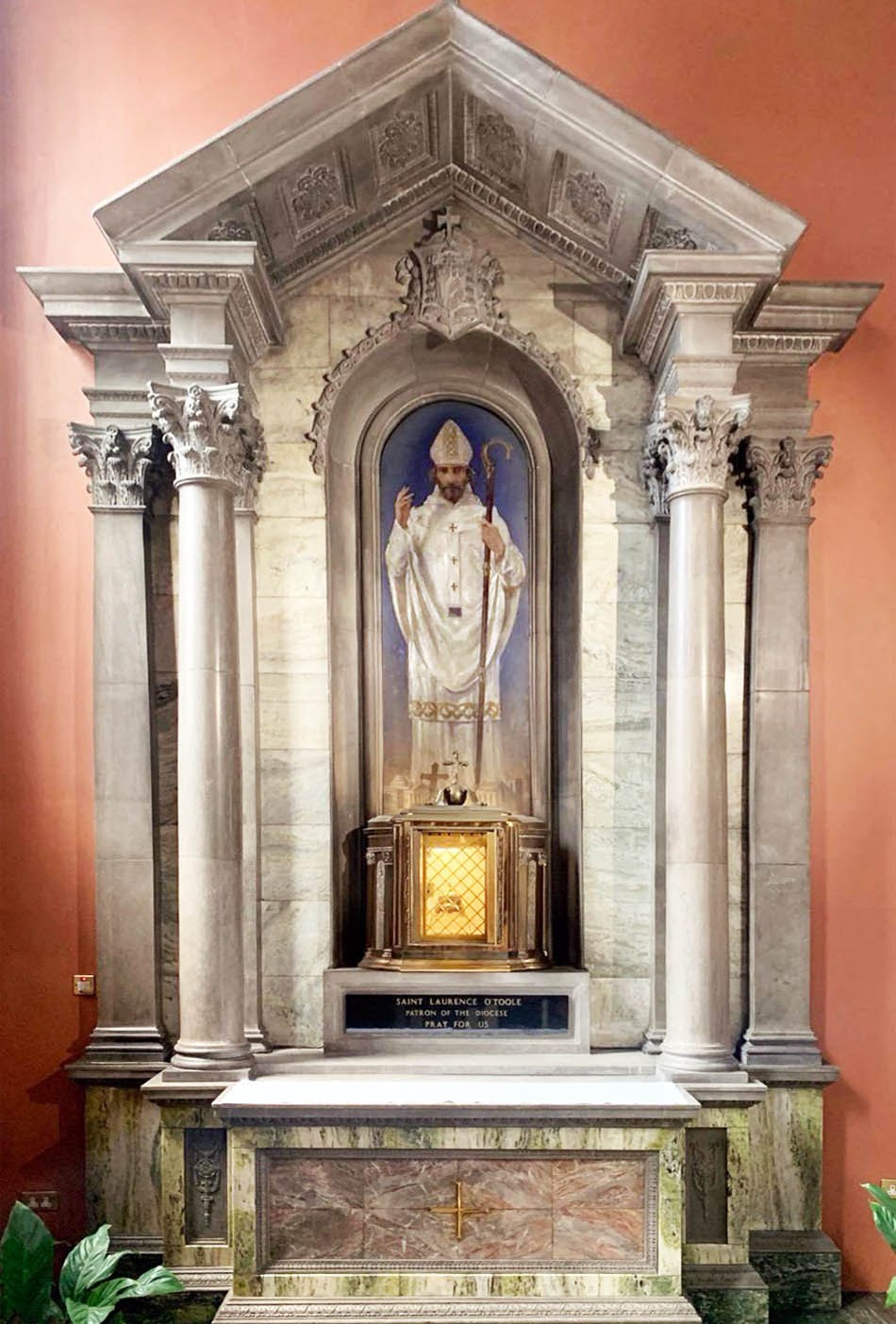
The altar of St Laurence O’Toole
So today, as we reflect upon two hundred years of St Mary’s we are left with a choice. Do we lament the past and wish for its return or seek ways of looking forward with hope filled hearts, responding to the new questions we face in a complex and changing culture? When I reflect upon the life of Jesus in the Gospels, I see someone who was always looking forward! As his disciples we need to do the same, while always learning from the past.
Today as Church, we find ourselves in a complex place. Our mission of sharing the Gospel is carried out in a more secularised context. I believe it is very important to navigate this new context, not as a decline, but as an opportunity for deeper, more authentic faith that offers a sense of meaning, hope and community in an increasingly fractured society. Fr Michael Paul Gallagher, the late Jesuit priest was prophetic in this when he asked a number of important questions, namely: ‘Behind the statistics of religious decline, what is happening to people’s spiritual imagination? What is really happening to people’s deeper selves? What is happening to their felt meanings and values?’ (Gallagher, Michael Paul, Religious Readings of our Culture, in Studies, Vol. 94, No. 347, Summer 2005, p. 148.)
These are the deeper questions we might reflect upon in this age. In my experience, I sense that there is something new emerging in the present time. I’ve noticed some interesting trends on Social media, especially among young people. Social media has its many drawbacks and distractions; however, the trends are important to observe. I have also seen this in meeting young people personally. There is a sense that many young people have travelled the noisy secular road and are finding it empty. They find themselves existentially adrift and this is leading to them to asking deeper questions such as: ‘Who am I? What is my purpose? Where do I find meaning? What do I have to offer to world?’
These are significant questions that open possibilities and offer an opportunity for the Church to engage with the search deep within the human heart. The narrative today that constantly puts forward a certain stereotype of the Church that it is anti-intellectual and deals in the sphere of myth, needs to be challenged. The Church’s intellectual tradition as well as its richness in the areas of prayer, Christian meditation, art, music, education, healthcare, service of the poor and marginalised are all ways of drawing us into the deeper mystery that is God’s love for each one of us, a love that ultimately offers us the meaning and hope we long for.
Archbishop Troy and the people who were behind the vision and building of this Cathedral could never have imagined where we would be at as a Church two hundred years on after they opened St Mary’s in 1825. What they did at that time was sow the seeds for what was to come. In a sense we find ourselves in a similar position. We have no idea what it will be like in ten to twenty years, let alone two hundred. But our call is the same and that is to sow the seeds of a future filled with hope. Fr Vincent O’Donovan, a Canadian priest who felt called to serve the Maasai tribe in Tanzania in the 1970s. He documents this journey it in a book called Christianity Rediscovered. Before departing on his mission, he was teaching a group of young students when one of them said to him: ‘In working with people, do not try to call them back to where they were, and do not try to call them to where you are, as beautiful as that place might seem to you. You must have the courage to go with them to a place that neither you nor they have been before.’
The call of the Spirit today is to go out into the deep, to have the courage to go to a place we have never been before. Yes, a model of Church created over the past couple of centuries is dying here in Ireland, but something new is emerging. We are in that process, right here, right now. It calls on us to have trust in God’s plan, but also to be courageous and to find our voice again, which is the voice of the Gospel. The Gospel is transformative and is forever new and fresh and alive. It speaks to our reality in such a powerful way. In this threshold moment may we open our hearts to the hope filled Gospel of Jesus Christ and renew our commitment to living and sharing it so as to transform the world with the love God has poured into our hearts!